B4QR Volume 2, Issue 2 Out Now

The Spring 2022 issue of the B4U-ACT Quarterly Review has just been released and is available here.


This issue continues the second volume of B4QR, and includes short critical summaries of eight studies published between June 2021 and February 2022. The featured scholar in the “Meet The New Generation” section of this issue is Jasmin H. Stevenson, a doctoral candidate at the Nottingham Trent University. The full text is available to read for free on our site.

Click here to display content from www.b4uact.org.


B4U-ACT 2021 Accomplishments

The following is a special message from B4U-ACT chairperson and co-founder Russell Dick. Previously sent to some donors and members of groups affected by our work, it is an account of B4U-ACT’s accomplishments in the year 2021 across its many programs and activities.


One of the primary educational events of B4U-ACT had been annual workshops for therapists, students, academics, and MAPs that were co-planned and co-led by therapists and MAPs. The success of these workshops was largely due to therapists having the opportunity to get to know MAPs through hearing their life stories in-person and chatting with them at their shared table during lunch and session breaks.  Unfortunately, the pandemic prevented the workshops the past two years. With the workshops relying upon the face-to-face interactions of therapists and MAPs, it was decided not to have virtual workshops.

Despite the pandemic preventing us from having the workshops for the past two years, B4U-ACT has remained active and dramatically expanded our outreach. In 2019, we began a Research Email Group for international researchers conducting studies related to the wellness of MAPs. The goal is to help researchers network and support each other, and to nurture a community of researchers studying MAP mental health and wellness. The group currently has 64 members, including graduate students, new researchers, and established researchers (including several internationally recognized “experts” on “pedophilia”), as well as minor-attracted people and mental health professionals.

The Research Email Group meets online once a month for a Research Colloquium during which a researcher presents his/her recently published or current research. Participants discuss the structure of the research, assessments used, interpretation of the data, implications for MAPs/researchers/therapists, and the implications for future research.

During the last year, we’ve consulted and provided input from minor-attracted people to researchers on 16 new and ongoing studies. These studies were on a broad range of topics pertaining to MAPs and have involved 25 different researchers representing 15 academic institutions in Canada, the United Kingdom, Finland, New Zealand, the Netherlands, Belgium, Cyprus, Indonesia, and the United States.  When the research sufficiently addresses issues that B4U-ACT supports and involves surveys of MAPs that do not contain false assumptions or stigmatizing perceptions, we announce them on our website and within our Peer Support Group so that MAPs might volunteer to participate in the studies. We are also in the early stages of collaboration with five other studies.

In January 2021, we published the first issue of our new quarterly online research review journal, B4QR, with short, critical summaries of new research concerning minor-attracted people. The five reviewers included not only researchers and students, but also minor-attracted persons. The first issue covered eight studies published between August and November 2020, on topics ranging from the categorization of mental disorders to the current state of research on child-like sex dolls, and much more.

The Spring online edition of B4QR presented reviews of eight articles published (usually in preprint) between December 2020 and March 2021. It had numerous research articles that focused on the issue of MAP stigma and interventions for stigma reduction. This shows that the topic of MAP stigma is a very hot one in the sexuality and therapy research about MAPs right now, which is a reality that would have been unthinkable just a few years ago.  

The Summer 2021 edition of the Research Journal included reviews of seven recent publications. The first three concerned one of our core topics of interest: the stigmatization of minor attracted people. The following two publications investigated mental health professionals’ knowledge and attitudes on issues related to minor attraction. The last two publications address methodological and theoretical issues in the study of the prevalence of minor attraction in the general population. The journal concluded as usual with the “Meet the New Generation” honoring a young scholar.

The summer of 2021 saw the publication of a landmark book for the field of MAP research: Professor Allyn Walker’s A Long Dark Shadow: Minor-Attracted People and Their Pursuit of Dignity. Therefore, the Fall 2021 issue of B4QR dedicated a special review for this important book. The next three articles reviewed covered different but equally interesting topics: MAP’s reasons for having or desiring romantic and sexual relationships with adults; the coming-out process of 16 men recruited via the online forum of the Czech and Slovak Pedophile Community; and an examination of the association between treatment motivation and “maladaptive coping” (e.g., substance abuse) among MAPs. The final two reviews are studies on the prevalence in the general population of attraction to children. We again honored a young scholar in the “Meet the New Generation” section that concludes the journal. All issues of B4QR are available for free on our website under the Research tab.

The latest issue of our online Newsletter included news updates, a special report on MAP Mental Health During the COVID-19 Pandemic, and A Therapist’s Perspective on the B4U-ACT Referral Service.

When B4U-ACT was established in 2003, the original focus was on developing a pool of qualified, non-stigmatizing, welcoming therapists in Maryland devoted to the well-being of MAPs and a MAP hotline through which MAPs would be referred to one of these therapists. However, we soon realized that most of the therapists wanting to work with MAPs were exclusively focused on protecting minors from MAPs and were not focused on the well-being of MAPs. We, therefore, began by having workshops for therapists. 

Fortunately, we were eventually able to develop a Signatory Therapist Program for qualified therapists who agree to abide by B4U-ACT’s Principles and Perspectives of Practice, and our pamphlet Psychotherapy for the Minor-Attracted Persons. MAPs who contact B4U-ACT seeking a therapist who will focus on their wellbeing are referred to one or more of the Signatory therapists. In 2021 we averaged 15 requests for referrals each month. Unfortunately, however, we only have a small number of Signatory therapists and we only have Signatory therapists in 16 states and 3 countries, leaving 34 states unrepresented in our signatory mix. In November and December, we had requests from 23 different states.  Over the year we also had requests from MAPs in Canada, the United Kingdom, Australia, Vietnam, Argentina, and Columbia. 

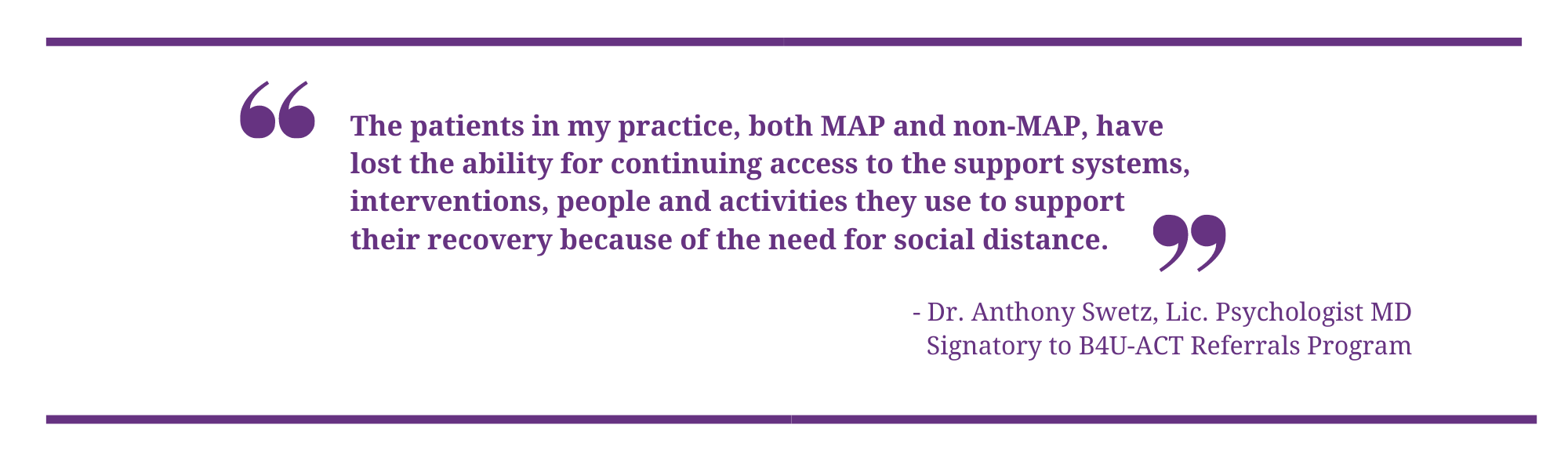
As a result of the pandemic and the social distancing around the world, there has been an increase in the demand for mental health services. Minors and adults who are attracted to minors, who were already responding to the demonizing messages about MAPs with depression, suicidal thoughts, anxiety, and social isolation, feel even more socially isolated during the pandemic. [See our Newsletter article “Where Stigma Meets Isolation – Mental Health Support for MAPs During COVID-19”: B4U-ACT Newsletter Spring 2021]

Our limited number of Signatory therapists have full caseloads and are frequently unable to take more clients. State licensing requirements generally require therapists to be licensed in the state in which their client lives, so even with the increased utilization of online therapy during the pandemic, MAPs in the 34 states in which we lack Signatory therapists are often left without an available therapist.  B4U-ACT needs more therapists throughout the country and the world to apply to be in the Signatory Therapist Program. As seen above, there is a high demand among minors and adults who are attracted to minors. For information on how to apply: How to Apply to Be a Signatory Therapist

We continued to have our monthly online Dialogue on Therapy discussions with therapists, researchers, students, and MAPs. Topics included: improving treatment programs for MAPs who have acted or are concerned they may do so; narratives about MAPs (explicit or implied) that are commonly found in professional articles about MAPs; the connections among intimacy, sexuality, and mental health, and how they apply to MAPs; B4U-ACT’s guide to Psychotherapy with Minor-Attracted Persons; MAPs’ interactions and/or relationships with children and adolescents; how therapists might support MAPs having more fulfilling romantic and sexual lives; meeting the needs of MAP youth; and, the effects of the Allyn Walker controversy.

Our Peer Support Forum moderators brought a number of issues to the Board: clarification of their goals and function; supporting freedom of expression and dealing with differences of perspectives and beliefs; responding to anonymous participants in crisis (e.g., suicidal or homicidal); and, how to best serve the needs of the participants.  They developed a survey to solicit input from the participants.  They also reached out to the Signatory therapist group to receive guidance on how to respond to participants in crisis and will be developing a procedural guide for how to effectively respond to participants in crisis. The Peer Support Forum’s website is being redesigned and will be implemented in coming months.

The Family and Friends Support Group had minimal participation in 2021, but we remain hopeful that more family members and friends of MAPs will join. Previous participants have reported how useful it was to them, particularly when they were first learning of their family member or friend’s orientation to minors and needed information and support in responding to their loved ones.

Our volunteer web designer is currently working to develop a new, high-quality website for B4U-ACT. We look forward to its implementation and new features.

B4U-ACT is frequently contacted by incarcerated persons who are attracted to minors who have had little or no information provided to them about persons like them, the causes of their unique orientation, how to understand it, how to deal with it within a society that villainizes them, the myths surrounding attraction to minors, and how to accept their orientation and choose not to have sexual activity with minors, while leading a happy, productive, and fulfilling life.  They want information about B4U-ACT and other resources. Persons who are currently incarcerated are without access to the Internet and want copies of information from our website.  During 2021 B4U-ACT sent over 80 letters and printouts responding to such inquiries.

As you can see from the above, B4U-ACT continues to be unique in that persons who are minor-attracted are involved in planning and conducting all that we do.  They are members of the Board, they co-plan and co-lead the workshops, they make presentations at university sexuality classes, they moderate the online Peer Support Group, they compile and publish the online Newsletter, they are among the reviewers who compile the Quarterly Research Review Journal, they assist researchers in designing research that doesn’t contain false assumptions about MAPs, and they volunteer to participate in the research that we think will seek non-stigmatizing and factual information regarding persons who are attracted to minors.

B4U-ACT has no paid staff and accomplished all of the above with a small number of dedicated volunteers.  Despite not having workshops the past two years, we nevertheless have numerous ongoing expenses: post office box rent, Board liability insurance, Maryland NonProfits membership, domain name renewals, software updates, postage, etc. Although we were started with a grant from the State of Maryland, we no longer receive that grant. We are totally dependent upon individual donors.  Anyone wanting to donate to support all that we do can make donations at https://www.b4uact.org/get-involved/donate/.

Russell Dick, MSW
Chairperson & Co-founder
B4U-ACT, Inc


B4QR Volume 2, Issue 1 Out Now

The Winter 2022 issue of the B4U-ACT Quarterly Review has just been released and is available here.


This issue commences the second volume of B4QR, and includes short critical summaries of eight studies published between April and November 2021. The featured scholar in the “Meet The Next Generation” section of this issue is Harriet Dymond, a doctoral student at the University of Nottingham. The full text is available to read for free on our site.

Click here to display content from www.b4uact.org.

B4QR Issue 4 Out Now

The Autumn 2021 issue of the B4U-ACT Quarterly Review has just been released and is available here.


This issue includes short critical summaries of five studies published between February and July 2021, as well as of the recent book “A Long Dark Shadow: Minor-Attracted People and Their Pursuit of Dignity” by Allyn Walker. The featured scholar in the “Meet The Next Generation” section of this issue is Sarah Moss, from the University of Guelph in Ontario, Canada. The full text is available to read for free on our site.

Click here to display content from www.b4uact.org.


B4QR Issue 3 Out Now

The Summer 2021 issue of the B4U-ACT Quarterly Review, has just been released and is available here.


This issue includes short critical summaries of seven studies published between February and June 2021. The featured scholar in the “Meet The Next Generation” section of this issue is Maria Sklavou, from the University of Sheffield. The full text is available to read for free on our site.

Click here to display content from www.b4uact.org.


A Therapist’s Perspective – Dr. James Cates

This article was originally published as part of our Spring 2021 Newsletter. Click here for the full issue.


The B4U-ACT Referral Service: A Therapist’s Perspective
James A. Cates, PhD., ABPP

The B4U-ACT referral service relies on counselors who have been vetted and approved to offer services to MAPs requesting help. But what skills are needed to become a mental health provider (MHP) for a MAP? No doubt there are as many answers as there are MHPs offering services. Two warning labels attach to this article. First, at b4uact.org, a tab labeled “For Therapists” has excellent information for MHP involvement with the organization, with much more specificity than I provide. Second, this list is based on my experience counseling sexual minorities (including MAPs), those who have sexually offended, and those who have been the victims of sexual offenses. With that in mind, consider the following essential criteria:

1. Comfort with one’s own sexuality. As we mature and life circumstances change, perceptions of our sexuality, sexual orientation, and intimacy evolve. A willingness to challenge and be challenged by these internal changes is essential for the MHP who intends to serve the minor-attracted population.

2. Discerning the difference between respecting and accepting the views of others. MAPs seeking care through B4U-ACT know that the organization strives to protect children. Still, there are differing views on how a child can be harmed. If a client respects the law, the goal of the MHP is not to change these views. In a broader context, MHPs meet with clients whose viewpoints are routinely set aside for the therapy hour. Differing views on religious beliefs or politics never become an issue. In contrast, boundaries with children becomes a focal point of treatment for a MAP. Therapists must respect differences of opinion, even when they do not accept the viewpoint of the client.

3. A corollary to this principle is the ability to stand among the trees and still see the forest. MAPs who feel safe with their MHP might report longings and desires demonstrated in overt behaviors. Whether these behaviors place a minor at risk can be open to interpretation. MAPs overcome tremendous fear to meet with a professional. The MHP who too readily reads abuse into any suspect behavior, rather than rationally considering context, intent, and the applicability of reporting laws, risks victimizing the client.

4. An understanding of the differences between MAPs and those who sexually offend. Not all persons who sexually offend are MAPs, and not all MAPs sexually offend. There are multiple reasons that a person can engage in a sexual offense, and not all sexual offenses target minors. MAPs identify as attracted to younger persons, of varying ages. Treatment interventions for those who sexually offend may be appropriate for MAPs who have engaged in illegal sexual behavior. For those who have not offended, however, there is no evidence that such treatment is beneficial. In addition, treatment for sexual offending is targeted specifically to reduce the risk of re-offense. It does not address the broader spectrum of minor attraction as a sexual orientation.

5. Capability to empathize with both victims of sexual abuse, and people who identify as MAPs. MHPs are aware of the frequency of sexual abuse against children. Because people identify as minor-attracted, it does not exempt them from the potential to have experienced unwanted, and even traumatic sexual acts perpetrated upon them in childhood. If so, they need support to explore the impact of abuse on their perceptions of sexuality and intimacy, every bit as much as persons with other orientations.

6. A willingness to educate both fellow professionals and the public about MAPs. Pervasive prejudices and stereotypes mean that mental health providers who offer treatment must also function as advocates. Erving Goffman has said, “Stigma is the process by which the reactions of others spoils normal identity.” Many MAPs, especially those whose orientation is a closely guarded secret, live in the shadows, fearful that they will be outed and despised by those with whom they interact. Only in demonstrating solidarity and support can we further affirm their worth.

The MHP whose skill set includes the ability to work with MAPs is much-needed. I do not fault those whose skills fall outside this population. (Over the years, I have found my limits. For example, there have been periods when I was determined to learn the art of play therapy, diving into books and workshops, only to find myself once again thoroughly enjoying playing with a child, with no clue what therapeutic benefit we were achieving.) Every MHP has areas of expertise. To those who work with MAPs, you have my respect, and my thanks.


B4U-ACT would like to thank Dr. Cates again for contributing this piece. For more information on this topic, see our guide “Psychotherapy for Minor-Attracted Persons” and our Principles and Perspectives of Practice.

B4U-ACT Quarterly Review: Issue 2 Out Now!

The second issue of B4QR, our quarterly review publication, has just been released and is available here.


This issue includes short critical summaries of eight studies published between December 2020 and March 2021. Many articles published in this time period took on the issue of stigma around attraction to minors and efforts to reduce it, while others included research on supportive services for minor-attracted people and attempts to understand attraction to minors within the field of neuroscience.

Thank you to our committee members for this issue, Harriet Dymond, Sarah Moss and Gary Parmlee, and to Kailey Roche for agreeing to be the our next featured young scholar.

Further issues and updates about B4QR will continue to be available on this site. We hope you enjoy, and find the journal informative and helpful!


Pandemic Impacts – Mental Health Support for MAPs during COVID-19

[vc_row][vc_column][vc_column_text css=””]

This article was originally published as part of our Spring 2021 Newsletter. Click here for the full issue.


One year ago, in spring 2020, the novel coronavirus became truly recognizable as a global pandemic. The first deaths outside of China, including in Europe and the United States, were reported in February, and by the end of March, widespread lockdowns had brought daily life to a halt. The direct impact of the disease over the last twelve months has been both immense and tragic, with over 2.5 million recorded deaths worldwide. But, although it is widely discussed, the mental health impact of the pandemic is harder to measure.

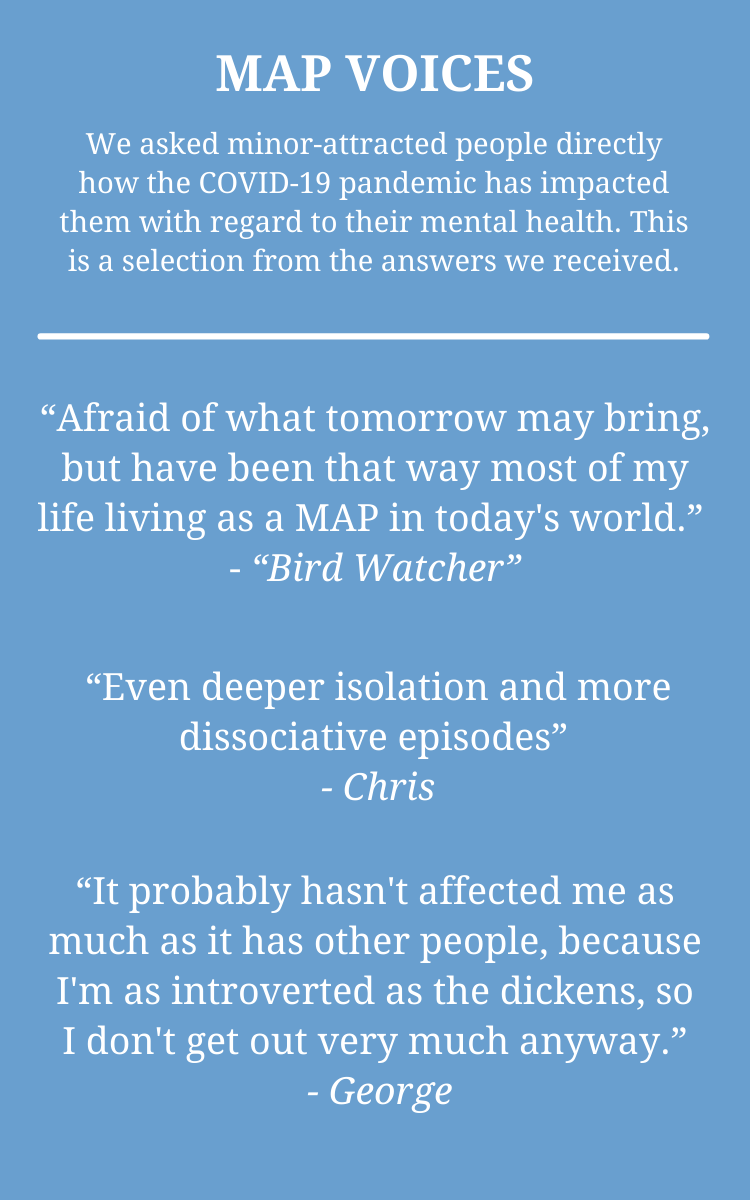
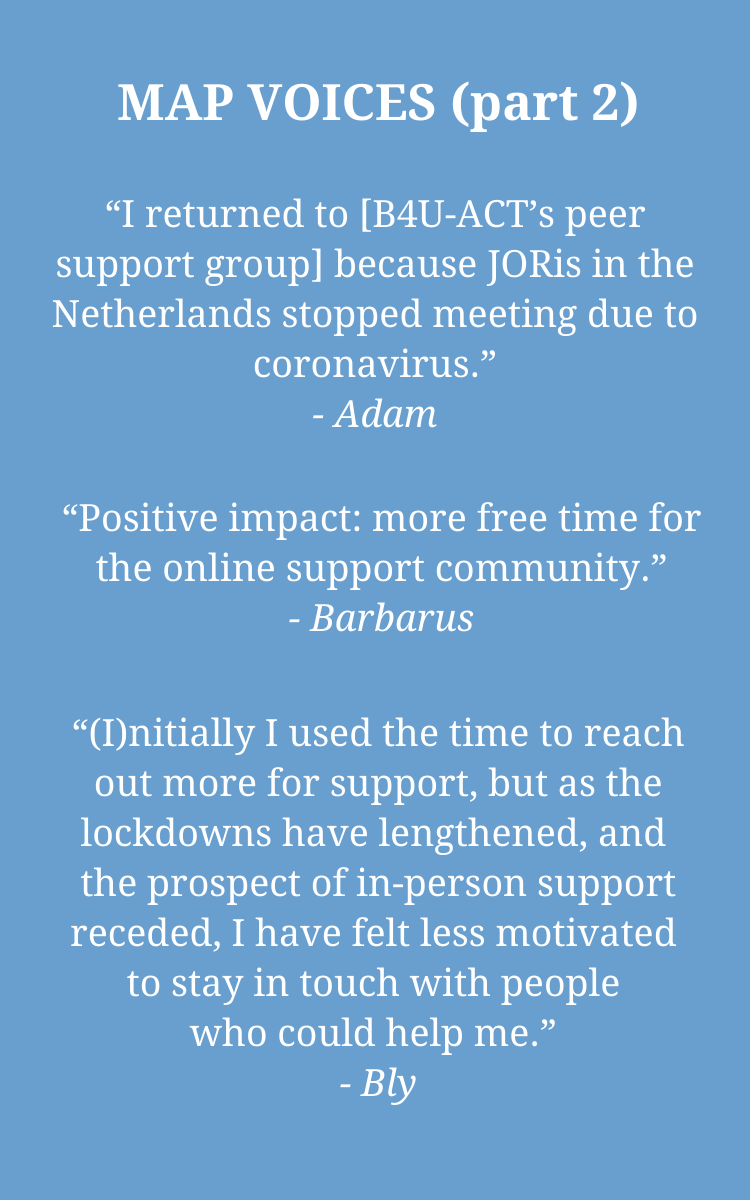
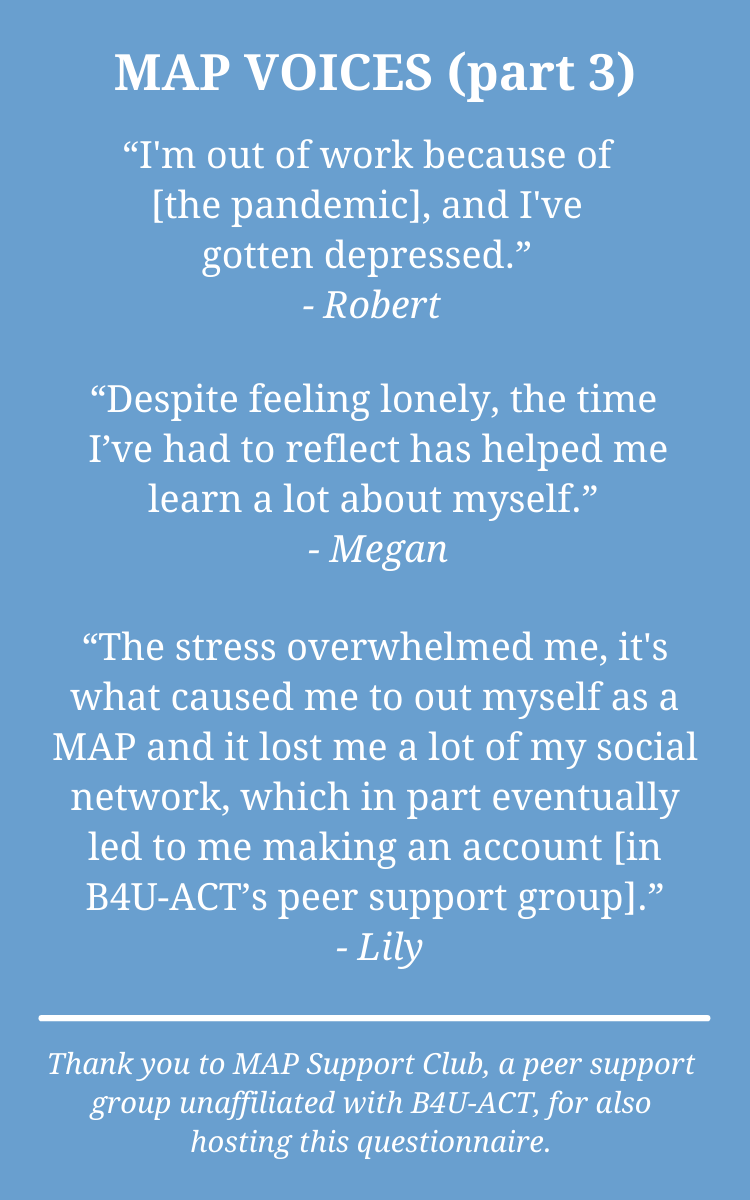
We do know that the pandemic has decreased measures of mental health around the world. The B4U-ACT Signatory and Referral Program has also seen a sizable increase in requests for mental health care during this time. No studies have yet attempted to document the effects of the pandemic specifically on minor-attracted people. So, for context on how MAPs specifically may be impacted, we reached out both to therapists in the program and to minor-attracted people in various communities, including B4U-ACT’s own peer support group. The responses show the myriad of ways in which a singularly isolating year has impacted a uniquely demonized group of people.

The therapists who responded to our question about what had changed during the past year gave mixed answers. While none reported having any MAP clients who indicated that they were seeking therapy as a direct result of the pandemic, there were other indicators of the effect it has had.

Brian Finnerty (LPC), one of the therapists to whom B4U-ACT refers MAPs, has started working with multiple new clients since the pandemic began. “Of the six MAPs on my caseload right now, four of them began their work with me during COVID,” Finnerty told B4U-ACT. “No one has explicitly stated that COVID had any link to their decision to seek therapy. But I suppose having extra time at home and being exposed to additional stressors could have been a motivating factor in seeking out therapy.”

To understand the impact the pandemic has had, it’s first important to understand that minor-attracted people reach out to B4U-ACT’s referral service for a variety of reasons. Some may be dealing with stigma and minority stress related to their sexuality, while others may have general mental health concerns (e.g., anxiety, stress, relationship problems, substance abuse) for which they feel uncomfortable seeing a therapist who may be hostile to their sexual identity, distress over their sexual attractions directly, or a combination of these and other issues.

Pandemic related stressors can intensify any of these concerns, but also can’t be considered the only factor, even as requests for support increase. For example, Sona Nast (MSSW, LCSW, LSOTP), another therapist to whom B4U-ACT refers MAPs, noted of one client that while “these stressors have been topics of discussion during treatment, most of the issues he is working on have been long-standing and unrelated to the pandemic.”

Without dedicated studies, it’s not yet possible to measure whether mental health has been significantly more affected for MAPs than for other groups, or whether MAPs have been affected in a substantially different way. But it has become increasingly evident throughout the pandemic that marginalized groups have faced a disproportionate amount of its harms.

Research points to social support networks as a protective factor against adverse mental health effects. In addition, a recent study in Journal of Homosexuality identified gender and sexual minorities (although attraction to minors was not explicitly mentioned) as disproportionately more affected during this time by symptoms of anxiety and depression, and having lower perceived social support. With this in mind, it’s reasonable to consider that MAPs might have been more susceptible to the stresses of a pandemic that has left all of us more fatigued and lonely.

Research on minor-attracted people elucidates how mental health is greatly impacted by the stigma surrounding their attractions. Social withdrawal and avoidance are more common among MAPs as a result. B4U-ACT’s Summer 2011 survey of MAPs found that over half of those who had seen a mental health professional mentioned dealing with society’s negative response to their attraction as part of their goals. The need for MAPs to keep their attractions secret, and fear of discovery, can be debilitating to networks of social support, and result in increased levels of loneliness and isolation.

“I think COVID has affected us all,” Brain Finnerty reflected, “but I suspect that communities which already tend to be more isolated have probably struggled a bit more.”

Michael Harris, director of B4U-ACT’s Signatory and Referral Program, brought up another subgroup that might be particularly affected. “We have certainly seen an increase in requests during the pandemic,” Harris reported, “and an alarming number of them have come from minors themselves… In recent months we have heard from MAPs as young as 12 who are seeking help.”

Research indicates that minor-attracted people usually begin to realize that their sexuality is different from their peers’ in late childhood or adolescence, and youths beginning to realize they are attracted to younger children are especially at risk when it comes to adverse mental health outcomes, including suicidal ideation and suicide attempts. Given findings that children and adolescents in general have been at higher risk of depression and anxiety symptoms during the pandemic, the need to reach these people with care has never been greater.

While the B4U-ACT Signatory and Referral Program represents a venue through which this need can be met, more efforts are needed. “Although our network of therapists is ever expanding,” Michael Harris explained, “we still do not have representation in all the areas of the country, or for that matter the world, where MAPs seek assistance, and so we are constantly seeking additional therapists.”

The backbone of the Signatory and Referral Program is a confidential list of therapists who are willing to provide compassionate, affirming therapy for MAPs that meets their needs. We do not publicly disclose any therapist’s presence on the list without their explicit permission. Instead, MAPs seeking therapy are sent names and contact information from professionals on the list who can practice (either face-to-face or telemedically) in their area. Therapists who join the list are also asked to reflect the goals and values in our Principles and Perspectives of Practice and our pamphlet Psychotherapy for the Minor-Attracted Person, which is crucial in assuring that the MAPs we refer receive compassionate therapy focused on their well-being.

While there are other therapist lists available to MAPs, our signatory based program, which affirms to MAPs that they will be treated in line with best practices, with compassion and responsively to their needs, is unique. Our 2011 survey found that over half of surveyed MAPs had wanted to see a mental health professional at some point in time, but did not do so, mostly due to fear of a negative reaction from the professional, or fear of being reported to law enforcement, family, employer, or community.

Signatories to the referral list are addressing these concerns by making their services available to MAPs who may not otherwise feel safe seeking support. As we all try to move through this difficult time, B4U-ACT is committed to expanding and improving our resources for MAPs to meet the growing need. This includes the effort to expand our list of participating therapists in the referral program, as well as broadening to include professionals in a larger number of geographical areas.

Minor-attracted people who are struggling and considering professional mental health support are encouraged to contact B4U-ACT via email at findtherapist@b4uact.org. Mental health professionals wishing to accept MAP clients are encouraged to contact the Signatory and Referral Program through Michael Harris at signatorylist@b4uact.org.


[/vc_column_text][/vc_column][/vc_row]

Announcing the B4U-ACT Quarterly Review (B4QR)

This week, we were pleased to announce the first issue of the B4U-ACT Quarterly Review (B4QR), which is available here.


Four times per year, B4QR will publish short critical summaries of new research concerning minor-attracted people. The first issue covers eight studies published between October and December 2020, on topics ranging from the categorization of mental disorders, to the current state of research on child-like sex dolls, and much more.

We’d like to extend special thanks to our committee members for this inaugural issue, Kailey Roche, Maria Sklavou and Max Geradt, as well as to Maggie Ingram for agreeing to be the first honored young scholar for the “Meet the New Generation” section of the journal.

Further issues and updates about B4QR will continue to be available on this site.

We hope you enjoy, and find the journal informative and helpful!