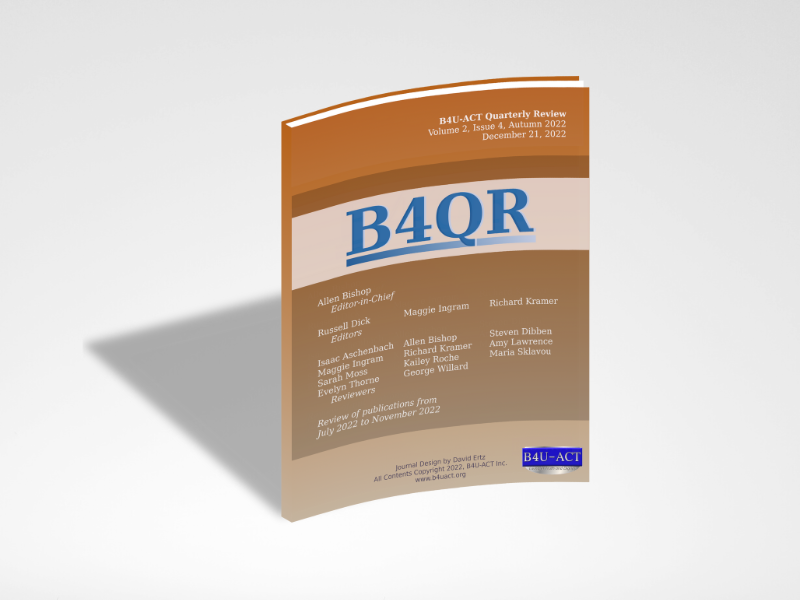
The Autumn 2022 issue of the B4U-ACT Quarterly Review has just been released and is available here.
This issue concludes the second volume of B4QR, and includes short critical summaries of six studies published between July and November 2022. The issue also includes a response from Dr. Christian Joyal to a review featured in the Summer 2022 issue, as well as a reply from Editor-In-Chief Allen Bishop. The featured scholar in the “Meet The New Generation” section of this issue is Dr. Evelyn Thorne, a postdoctoral fellow at the Moore Center for the Prevention of Child Sexual Abuse at Johns Hopkins Bloomberg School of Public Health. The full text is available to read for free on our site.
Click here to display content from www.b4uact.org.
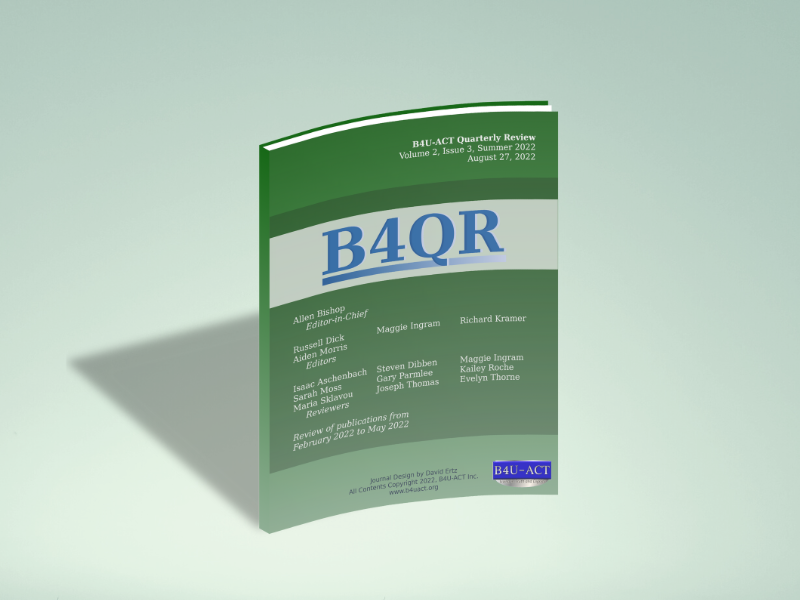
The Summer 2022 issue of the B4U-ACT Quarterly Review has just been released and is available here.
This issue continues the second volume of B4QR, and includes short critical summaries of six studies published between February and May 2022. The issue also includes a meta-analysis conducted by the B4QR team using recently published data on sexual victimization, pedophilic interest, and antisociality. The featured scholar in the “Meet The New Generation” section of this issue is Amy Lawrence, a doctoral candidate at the University of Auckland in New Zealand. The full text is available to read for free on our site.
Click here to display content from www.b4uact.org.
As terms like “minor-attracted person” or “MAP” have become more common among researchers, mental health professionals, and abuse prevention organizations, they have also become more contentious in the public discourse. In particular, conservative commentators such as Laura Ingraham and Tucker Carlson have voiced their disapproval of this terminology, while attempting to associate it with the political left, including LGBTQ+ rights movements.
However, according to survey results published this summer by the language learning website Preply, public opinion on this terminology is a near even split, regardless of political affiliation. According to Preply’s article on the results, only 45% of Democrats and 52% of Republicans indicated that the term “annoy[ed] them in practice.” The results are based on a survey of 1,012 Americans conducted in May 2022.
These results differed from other terms in Preply’s category of political or social justice terminology, which tended to be more tolerated by Democrats and less tolerated by Republicans.
Terms like “minor-attracted person” have the advantage of being more value-neutral than alternatives like “pedophile” or “hebephile,” as “pedophilia” carries strongly negative connotations and is often used incorrectly to refer to child sexual abuse. These negative associations can lead to real-world consequences: for example, a 2021 study found that students planning to become social workers were more likely to break client confidentiality and less willing to work with a client described as a “pedophile” than a client described as someone who is “sexually attracted to children, [who has not] committed an offence against a child.” The study authors went on to use the term “minor-attracted people” in their publication.
Additionally, some academic sources fail to distinguish between “pedophilia” and the condition of “pedophilic disorder” as described in the DSM-5, which requires additional factors beyond attraction to children or adolescents to be diagnosed. This confusion can lead to conclusions that are difficult to interpret, or applied to the wrong group of people entirely.
B4U-ACT has preferentially used the term “minor-attracted person” to refer to people who are attracted to children or adolescents since at least 2007. Before that, we had used the term “minor-attracted adults” for this purpose since our founding, before switching to reflect the fact that minor-attracted people usually begin to experience this pattern of attraction before they are adults.
While many researchers now use terms like “minor-attracted person” and “minor-attraction,” others still refer to “pedophilia,” and some have argued in favor of other alternatives, such as “child-attracted persons.” (See Michael Seto’s response to our review of his 2018 AASECT Plenary Talk)
Preply did not immediately respond to a request for more information about their survey.
The Spring 2022 issue of the B4U-ACT Quarterly Review has just been released and is available here.
This issue continues the second volume of B4QR, and includes short critical summaries of eight studies published between June 2021 and February 2022. The featured scholar in the “Meet The New Generation” section of this issue is Jasmin H. Stevenson, a doctoral candidate at the Nottingham Trent University. The full text is available to read for free on our site.
Click here to display content from www.b4uact.org.
The Winter 2022 issue of the B4U-ACT Quarterly Review has just been released and is available here.
This issue commences the second volume of B4QR, and includes short critical summaries of eight studies published between April and November 2021. The featured scholar in the “Meet The Next Generation” section of this issue is Harriet Dymond, a doctoral student at the University of Nottingham. The full text is available to read for free on our site.
Click here to display content from www.b4uact.org.
The Autumn 2021 issue of the B4U-ACT Quarterly Review has just been released and is available here.
This issue includes short critical summaries of five studies published between February and July 2021, as well as of the recent book “A Long Dark Shadow: Minor-Attracted People and Their Pursuit of Dignity” by Allyn Walker. The featured scholar in the “Meet The Next Generation” section of this issue is Sarah Moss, from the University of Guelph in Ontario, Canada. The full text is available to read for free on our site.
Click here to display content from www.b4uact.org.
The Summer 2021 issue of the B4U-ACT Quarterly Review, has just been released and is available here.
This issue includes short critical summaries of seven studies published between February and June 2021. The featured scholar in the “Meet The Next Generation” section of this issue is Maria Sklavou, from the University of Sheffield. The full text is available to read for free on our site.
Click here to display content from www.b4uact.org.
The second issue of B4QR, our quarterly review publication, has just been released and is available here.
This issue includes short critical summaries of eight studies published between December 2020 and March 2021. Many articles published in this time period took on the issue of stigma around attraction to minors and efforts to reduce it, while others included research on supportive services for minor-attracted people and attempts to understand attraction to minors within the field of neuroscience.
Thank you to our committee members for this issue, Harriet Dymond, Sarah Moss and Gary Parmlee, and to Kailey Roche for agreeing to be the our next featured young scholar.
Further issues and updates about B4QR will continue to be available on this site. We hope you enjoy, and find the journal informative and helpful!
This week, we were pleased to announce the first issue of the B4U-ACT Quarterly Review (B4QR), which is available here.
Four times per year, B4QR will publish short critical summaries of new research concerning minor-attracted people. The first issue covers eight studies published between October and December 2020, on topics ranging from the categorization of mental disorders, to the current state of research on child-like sex dolls, and much more.
We’d like to extend special thanks to our committee members for this inaugural issue, Kailey Roche, Maria Sklavou and Max Geradt, as well as to Maggie Ingram for agreeing to be the first honored young scholar for the “Meet the New Generation” section of the journal.
Further issues and updates about B4QR will continue to be available on this site.
We hope you enjoy, and find the journal informative and helpful!
For some time now, we have had on our website a (non-comprehensive) summary of research concerning MAPs. The summary is divided into key topics, and each topic comes with a list of relevant publications. In its current form, however, the summary cannot easily be accessed in its entirety. One needs to navigate through multiple webpages to read the complete summary.
To make things easier, we created a PDF document that contains the same information, but in a more reader-friendly format.